


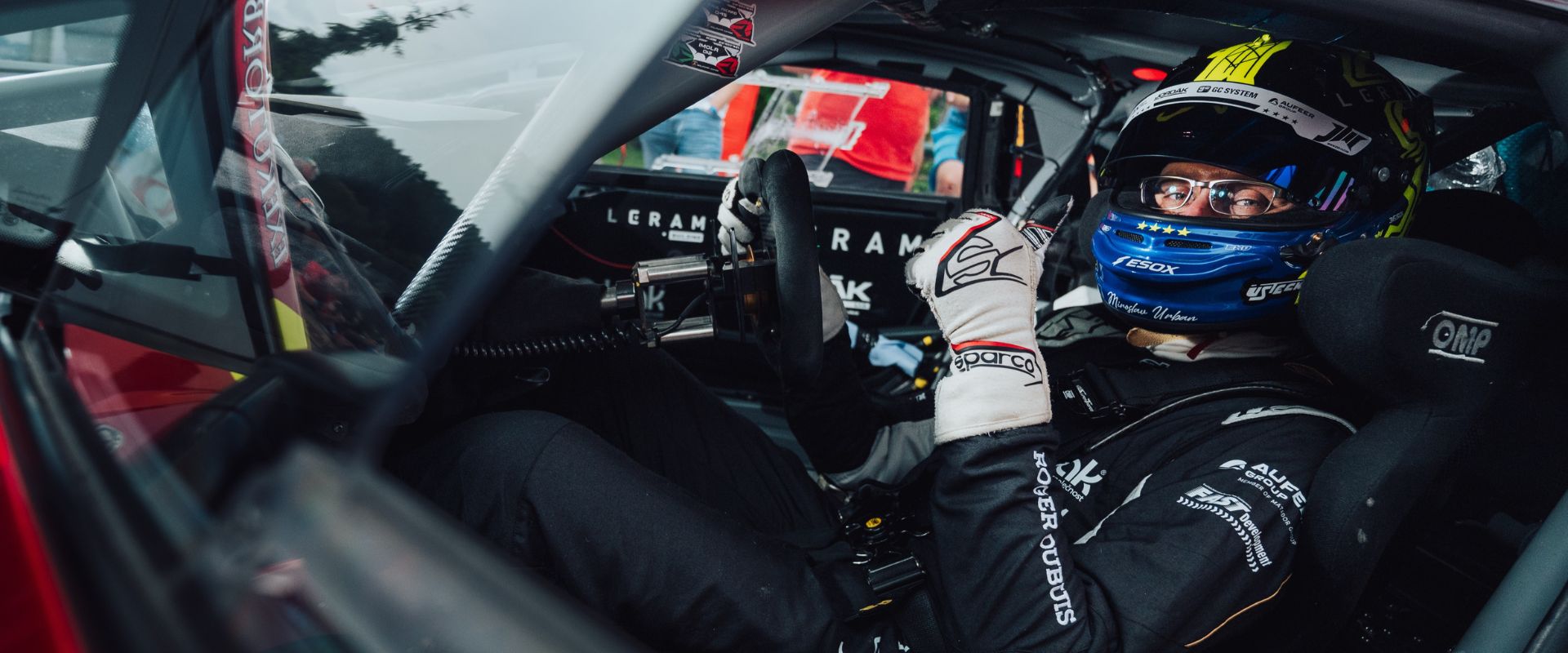
His team already has two European titles to its name. Now Jiří Mičánek is about to experience European championship competition away from the circuit scene. This weekend, he will line up for the first time at the iconic Ecce Homo hillclimb, the most famous and prestigious hillclimb event in the Czech Republic. “I’m approaching it with the utmost respect. It’s a very demanding course. At the same time, there’s no pressure on me. If anything, I can only surprise people,” says the team manager and driver.
You’re making your first start at Ecce Homo, but the Mičánek name is already well known there.
That’s true. My father competed here from the mid-1970s until 2000. He stood on the podium several times, with second place being his best result.
Does that create pressure? Or is it more of a challenge?
We’re in a completely different era and a completely different situation. This will be my first time here, and I’m approaching it with a great deal of humility and respect. Last weekend at Ústecká 21, I was speaking with Mr Krečmer, one of the legends of Czechoslovak hillclimbing. He told me that if you haven’t raced here at least five times, you simply can’t know the course properly. It’s something you have to learn through experience behind the wheel.
And what advice did your father give you?
To learn the course properly and drive it as many times as possible before the event.
Did you follow that advice?
I did. (laughs) I probably know the road to Šternberk better than the course itself by now. Over the last two weeks, I’ve driven there five times in a road car, and I’ll be making a sixth visit just before the race weekend.
Circuits can be learned on a simulator or by studying onboard footage. Doesn’t that work here?
It’s much more difficult. Modern wide-angle onboard cameras distort the perspective quite a lot. A corner looks completely different on video than it does in reality. At the end of the day, you simply have to drive the course yourself. You can learn it on a simulator to a degree, but it’s far more complicated than learning a circuit.
Why is that?
Because a simulator won’t show you where the bumps are. This isn’t a smooth racing circuit. There are lots of blind sections where you can’t see the exit, and you need to know exactly where you can commit and where you can’t. During the first few runs, it’s easy to confuse one corner with another. Finding the correct braking points is difficult as well. So far, I’ve only driven the course in a road car and within normal speed limits. I still don’t know how quickly I’ll arrive at each corner or how much grip there will be.
Will you have enough time during the weekend to get comfortable?
Not really. This is a European Championship event. We get two practice runs, and then on Sunday morning we wake up and go racing. And I’ll be hoping it stays dry.
How do you think the course will suit the Huracán?
We might actually have a slight advantage here. It’s a very fast course. The straight after Sojka Corner is almost a kilometre long, and speeds will approach 250 km/h. That kind of layout suits the Huracán. Compared to technical courses such as Ústecká 21, it should be much more competitive here.
What made you decide to finally take on Ecce Homo?
It’s something that’s appealed to me for several years. It’s the home round of the European Championship. I remember coming here with my father when I was a little boy. Until now, it never worked out because it clashed with the circuit racing programmes that remain our main focus. This is the first year everything has fallen into place.
Are you setting yourself any results targets?
Not at all. We’re facing plenty of challenges, and the field here is naturally extremely strong. I’m approaching the event with humility and respect. My mindset is simple: we can only exceed expectations.
